Research · Working Paper WP 2026-02 · November 2026
How often do Australian councils revalue their assets?
We read the rule each state sets and the audited financial statements of 100 councils across seven jurisdictions. The paper, the council-level data and the code are free to download.
Download
Full title: How Often Do Australian Councils Revalue Their Assets? Evidence from 100 Audited Financial Statements, 2024–25 and 2025–26. Landmark Valuations Working Paper WP 2026-02, November 2026.
What the paper asks
Councils carry most of their land, buildings and infrastructure at fair value. The accounting standard, AASB 116, asks only that revaluations be made with sufficient regularity. The paper asks what each state and territory adds to that standard, how old council valuations were at the latest balance date, and how much revaluations moved council balance sheets in a year. Councils were taken in random order from each jurisdiction’s official list, among those whose statements could be retrieved.
Three findings
Only Western Australia fixes an interval. Its regulations require land, buildings and infrastructure to be revalued every five years and do not require it earlier. New South Wales, Victoria, Queensland, South Australia, Tasmania and the Northern Territory set no interval beyond the accounting standard, although almost every New South Wales council writes five years into its own policy.
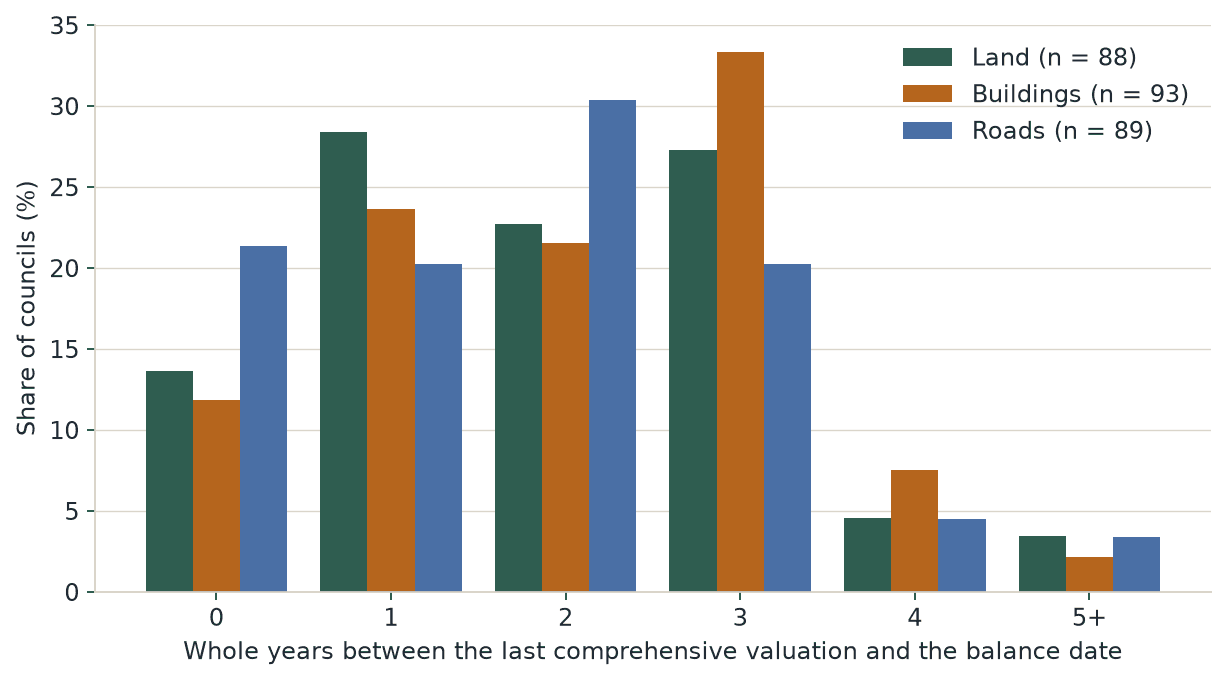
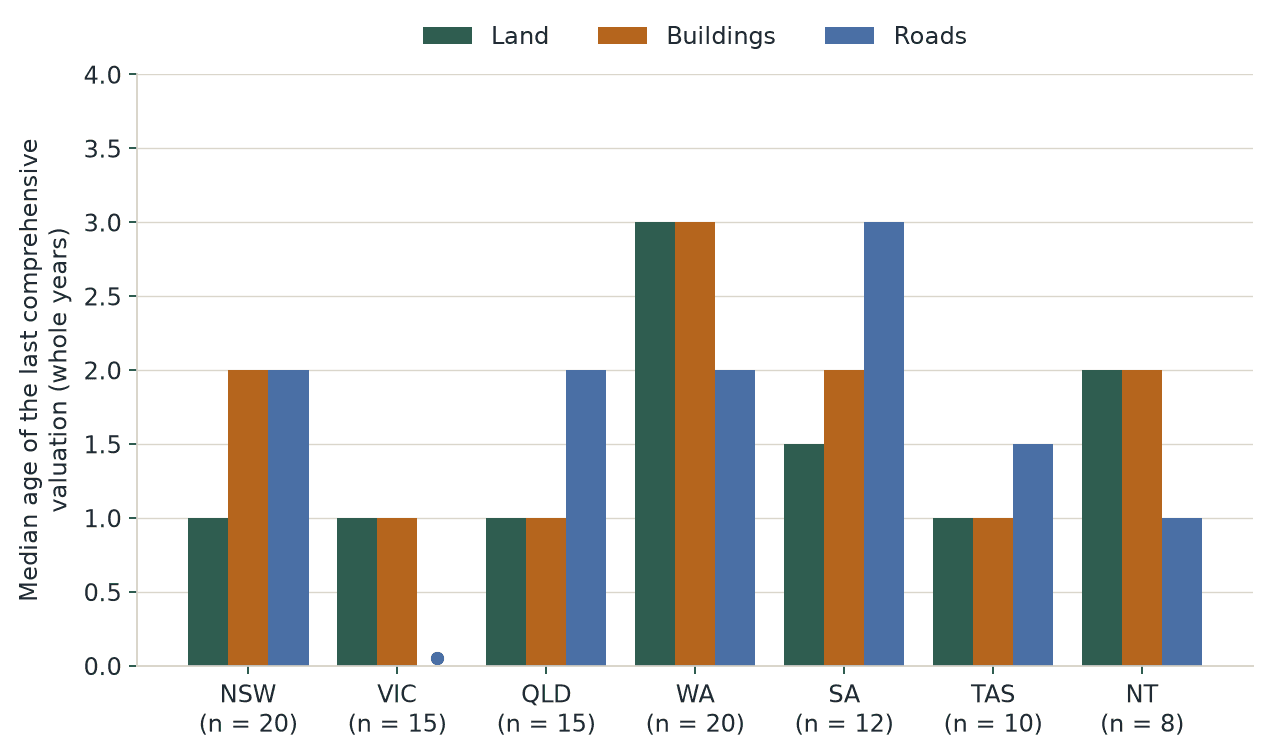
Most valuations are two years old or less. The last comprehensive valuation was a median of two years old for land, buildings and roads. 81 of 88 dated land valuations were three years old or less, and few councils let a valuation run past five years. That profile is what cycles of about four and a half to five years produce.
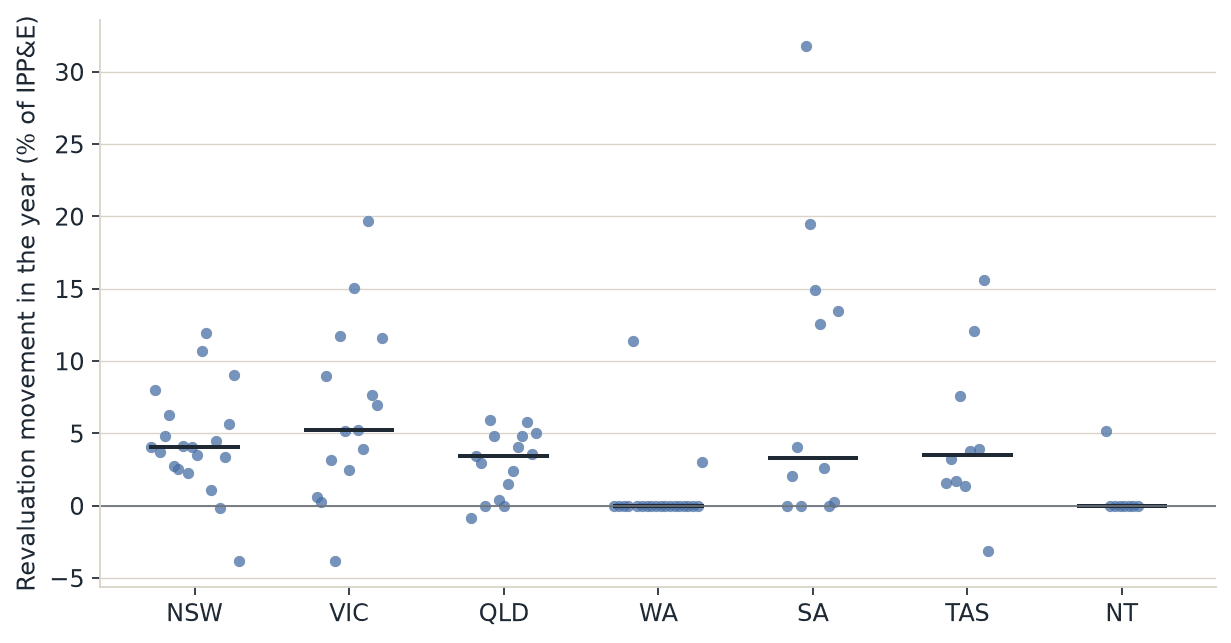
The difference is between valuations. In New South Wales, Victoria, Queensland, South Australia and Tasmania, 67 of 72 councils booked a revaluation movement in the year, by a comprehensive valuation of some class or by indexation: a median of 3.9% of the carrying amount. In Western Australia, where values are held at the last valuation until the next one, 2 of 20 did.
Figures
Data and method
- Rules: the regulation, code of accounting practice or model financial statements of each jurisdiction, read in the versions in force on 24 November 2026.
- Councils: 539 councils in the official lists; 131 approached in a fixed random order; 100 read, from their latest audited statements (47 for 2025–26 and 53 for 2024–25). Every date, valuer and policy in the dataset carries a verbatim quotation and a page reference.
- Checks: a second reader re-read twelve councils drawn at random; 81 of 84 values were confirmed and two were recoded.
Councils whose documents could not be retrieved, often large ones, are not in the sample, and about half the sample is read at 30 June 2025 and half at 30 June 2026. The paper sets out these and other limitations in full.
How to cite
Landmark Valuations Research (2026). How Often Do Australian Councils Revalue Their Assets? Evidence from 100 Audited Financial Statements, 2024–25 and 2025–26. Landmark Valuations Working Paper WP 2026-02. Available at https://www.landmark-valuations.com.au/research/council-asset-revaluations-2026
The paper, data, code and figures are released under CC BY 4.0.
Interest
Landmark Valuations values property and infrastructure and tenders for council revaluation work. The data, the collection protocol and the code are published so that every result can be checked. See also our asset valuations and financial reporting valuations.