Residential
Apartment Building Defects: 53% in the NSW Survey Have One, and Owners Pay

Add Landmark Valuations as a preferred source on Google
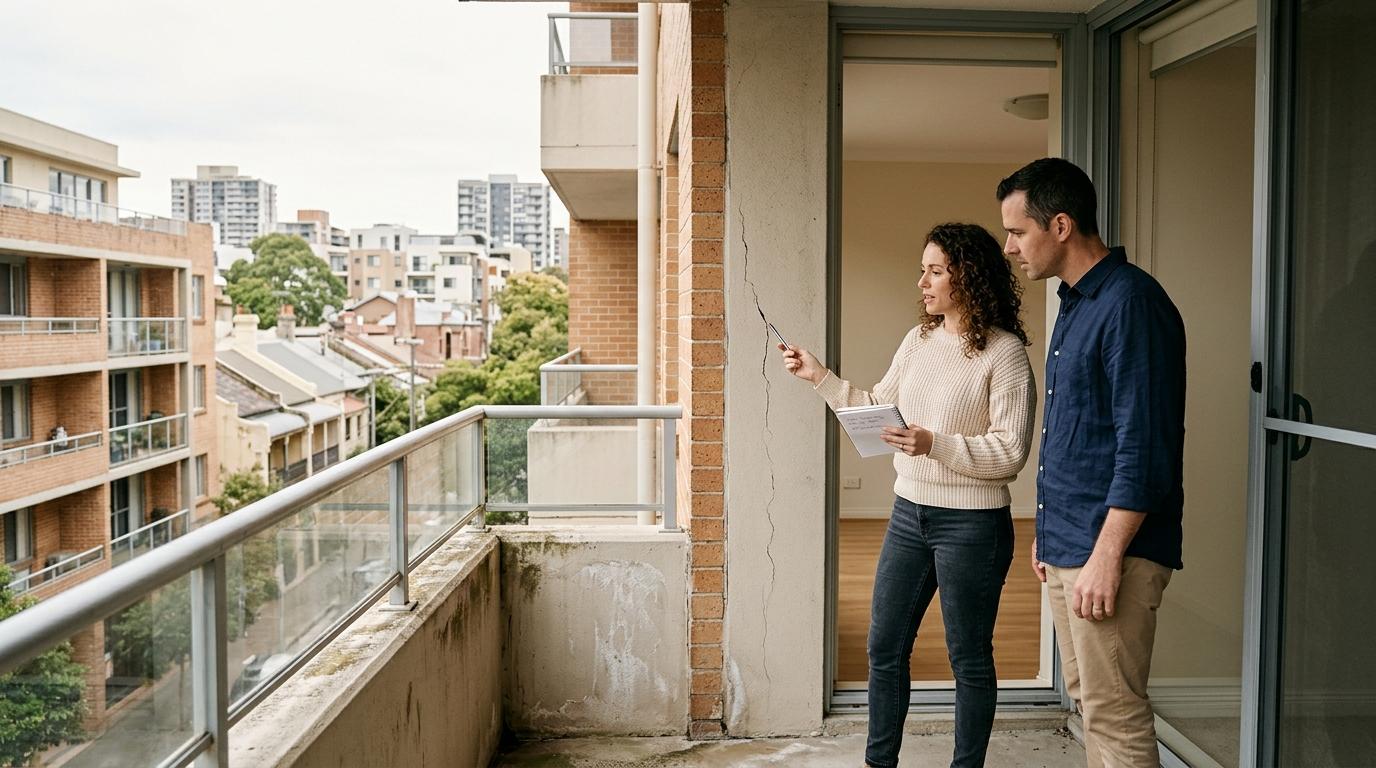
The NSW Government has surveyed strata managers about defects in recently built apartment buildings three times. The latest edition, published in November 2025, covers 520 buildings of four storeys or more registered between July 2018 and June 2024. 53% of them had a serious defect in the common property.
The same report puts a price on it. Where the cost was known, the average was $215,400 per building, and only 8% of those buildings had recovered any of it. The rest fell to the owners.
Those three numbers are the reason a buyer’s due diligence on an apartment has to reach past the front door of the unit. This article sets out what the surveys measured, where their limits are, and how defects show up in a valuation.
The numbers at a glance
| Measure | 2021 report | 2023 report | 2025 report |
|---|---|---|---|
| Buildings surveyed | 492 | 642 | 520 |
| Buildings in scope | Completed after July 2014 | Registered July 2016 – June 2022 | Registered July 2018 – June 2024 |
| Share with a serious defect | 39% | 53% | 53% |
| Average cost per building, where known | $331,829 | $283,000 | $215,400 |
| Buildings that recovered any cost | 3% | 9% | 8% |
| Reported the defect to the regulator | 15% | 34% | 36% |
All three surveys cover NSW apartment buildings of four or more storeys, and the answers come from the strata managers of those buildings. A “serious defect” means a defect in the common property affecting one of five building elements — waterproofing, fire safety systems, structure, the building enclosure, or key services — with non-compliant cladding counted alongside them.
Two cautions before reading across the columns.
The jump from 39% to 53% is mostly a change in the question. The 2021 survey asked about serious defects without showing a list. From 2023 respondents were prompted with one. The 2023 report says the rise “may be just as attributable to the change in the question wording (and probably more so)”. The 53% figures from 2023 and 2025 are comparable with each other. The 39% is not comparable with either.
The cost column is not a trend. Each figure is an average over a different set of buildings with known costs, and all three surveys asked managers to exclude amounts recovered. Read each as the scale of the bill in that sample.
Which defects, and how often
In the 2025 survey, as a share of all 520 buildings:
| Defect type | Share of buildings |
|---|---|
| Waterproofing | 44% |
| Fire safety systems | 28% |
| Building enclosure | 23% |
| Structural | 18% |
| Key services | 15% |
| Non-compliant cladding | 2% |
Waterproofing has led every edition: 23% of buildings in 2021, 42% in 2023, 44% in 2025. It is also a defect a buyer is unlikely to see at an inspection, because it typically sits in balcony membranes, roofs and basement walls.
A three-state pilot study counted defects differently. Johnston and Reid’s 2019 research for Deakin and Griffith universities analysed 212 building audit reports and found that 85% of the buildings had at least one defect across multiple locations: 97% in NSW, 74% in Victoria and 71% in Queensland. Counting individual defects, it put building fabric and cladding first, ahead of fire protection and waterproofing. That sample is made of buildings where someone had already commissioned an audit, so it describes buildings under investigation and should not be read as the defect rate for all apartment buildings.
A newer building is younger, which is a different thing from cleaner
The 2025 report breaks the result down by registration year. 69% of buildings registered in 2018 reported a serious defect, against 21% of those registered in 2024. The report flags the 2024 group as a small sample.
The simplest reading is time. Water takes a few winters to find its way through a membrane, and a building registered in 2024 has had one or two. The figure for a 2024 building is what has surfaced so far.
For a buyer this cuts against a common instinct. A two-year-old building with a clean record has not yet been through the period in which most defects are found, and any statutory warranty period is already running.
Who pays
In the 2025 survey, among the 211 buildings with confirmed defect costs, rectification was funded through the standard levy (65%), special levies (46%) and an increase in the annual maintenance budget (29%). Buildings could name more than one source, so the figures overlap.
Recovering any of the cost was rare: 17 of those 211 buildings, or 8%. In 2023 it was 9%, and in 2021 it was 3%.
An average of $215,400 is a per-building number. Spread evenly across 20 lots it is about $10,800 each, and across 50 lots about $4,300. Levies are struck by unit entitlement, so the real split is uneven. The arithmetic is only there to show the order of magnitude a single owner should have in mind.
Resolution is slow as well. Of the buildings where all rectification work was finished, 29% had it done within a year, down from 48% in the 2023 survey. Both figures rest on a few dozen buildings.
What the 2% bond does and does not cover
NSW requires the developer of a new apartment building of four storeys or more to lodge a building bond under the Strata Building Bond and Inspections Scheme, for building contracts signed on or after 1 January 2018. The bond is 2% of the contract price. A planned increase to 3% has been deferred until 1 July 2028. A developer can take out decennial liability insurance as an alternative to the bond, and that insurance is not mandatory.
The bond is there to pay for defective work identified through the scheme’s inspection process, and its size is fixed as a share of the contract price before anyone knows what is wrong with the building. In the 2023 survey, a developer bond was a funding source for 2% of the 279 buildings with confirmed costs.
The bond scheme is a NSW one. Victoria’s building regulator has been the Building and Plumbing Commission since 1 July 2025, when it took over the functions of the Victorian Building Authority. On cladding specifically, Cladding Safety Victoria reported 409 buildings rectified under its funded program to 30 June 2025. The terminology changes across borders too: owners corporation in NSW and Victoria, body corporate in Queensland.
What defects do to value
Published Australian evidence on the price effect is thin, and almost all of it is about cladding.
The best-identified estimate is Melser’s 2023 paper in Urban Studies, which studied Melbourne homes affected by combustible cladding using sales and rental data from 2005 to mid-2019. It found a decline of around 9% in the prices paid by owner-occupiers and around 3% in rents.
For waterproofing, structural or fire-safety defects we could not find a published Australian study that states both a number and a method. Anyone quoting a standard “defect discount” for those is guessing. The effect has to be worked out building by building, and it turns on a short list of facts:
- Is the cost known? A defect with an engineer’s scope and a quoted price is a liability the market can price. One described in the minutes as “under investigation” is priced as uncertainty, which is usually worse.
- Is it funded? A special levy already struck and paid by the vendor is a different position from one that will be struck after settlement.
- Who else is paying? A signed deed with the builder counts. An expectation that the builder will return does not.
- Can the unit be financed and insured? A lender that declines the building as security removes most of the buyers from the next sale.
- What have other units in the building sold for since the defect became known? That is the most direct evidence there is, and in a defective building it is often the only evidence that matters.
A valuer weighs those facts against comparable sales. A pre-purchase valuation is most useful when the valuer has been given the strata report, the last few years of minutes, any engineering reports and the levy notices before inspecting. A valuation does not replace a building inspection or a strata search. It tells you what the documented position is worth.
A separate question arises once rectification is finished. The sum insured for the building should be re-tested, because the replacement cost of a building with a new facade or membrane system is not the figure on the old policy. That is a strata insurance valuation, and it measures rebuilding cost, which has nothing to do with what a unit would sell for.
What to read before you exchange
The survey results point to five documents that carry most of the information.
- The minutes, for at least three years. Search for “water”, “membrane”, “engineer”, “rectification”, “special levy” and “fire order”. Repeated mentions over several meetings mean an unresolved problem.
- The capital works fund plan and the fund balance. NSW owners corporations must prepare a 10-year plan. Compare the balance with the works the plan says are due.
- Any engineering or defect report, with its date, its scope and whether a price is attached.
- Levy notices and any special levy resolution, plus the contract clause that says who pays a levy struck before settlement.
- The insurance certificate and claims history.
Then ask the lender to confirm that it will accept the specific building as security, in writing, before the cooling-off period ends.
Low levies deserve a second look. In the last two surveys, half or more of the buildings with confirmed costs paid for defects out of ordinary levies, so a building with unusually low levies and a known defect has not yet started paying.
Methodology
Figures for NSW come from the three editions of the NSW Government strata defects survey (2021, 2023 and 2025), read in the published PDFs. Each is a survey of strata managers about buildings they manage, restricted to class 2 buildings of four or more storeys. Percentages are shares of surveyed buildings, not of all NSW apartment buildings. The 2025 edition reports a response rate of 42% and a margin of error of ±3.3%. Cost averages cover only buildings where the cost was known.
We have not reported a median cost or cost as a share of building value, because the reports do not publish them. We have not quoted a current count for NSW’s Project Remediate cladding program, because the latest official figure we could verify dates from December 2023.
Frequently asked questions
How common are defects in new apartment buildings?
In the NSW Government’s 2025 strata defects survey, 53% of 520 apartment buildings of four storeys or more, registered between July 2018 and June 2024, had a serious defect in the common property. The 2023 survey returned the same 53% for buildings registered between July 2016 and June 2022. Both figures describe the buildings surveyed and come from their strata managers.
What is the most common building defect in apartments?
Waterproofing, in every edition of the NSW survey. It affected 44% of buildings in the 2025 survey, ahead of fire safety systems at 28%, the building enclosure at 23%, structural defects at 18% and key services at 15%. Non-compliant cladding affected 2%.
Who pays to fix defects in a strata building?
Mostly the owners. In the 2025 NSW survey, among buildings with confirmed defect costs, rectification was funded from the standard levy in 65%, special levies in 46% and an increased maintenance budget in 29%. Only 8% of those buildings had recovered any of the cost.
How much do building defects reduce an apartment’s value?
There is no reliable general figure. The one well-identified Australian study, on combustible cladding in Melbourne, found prices paid by owner-occupiers for affected homes fell by around 9%. For other defects the effect depends on whether the cost is known, whether it is funded, whether anyone else is paying, and what other units in the building have sold for since the defect came to light.
Does the NSW building bond cover defects?
Partly. Developers of new NSW apartment buildings of four storeys or more must lodge a bond of 2% of the contract price for building contracts signed on or after 1 January 2018. It pays for defective work identified through the scheme’s inspections and is capped at the bond amount. A rise to 3% has been deferred until 1 July 2028.
Sources:
- NSW Government — Strata defects research report 2025
- NSW Government — 2023 Strata defects survey report
- NSW Government — Research report on serious defects in recently completed strata buildings (2021)
- NSW Government — Strata Building Bond and Inspections Scheme
- NSW Government — Strata repairs and maintenance (capital works fund plan)
- NSW Government — Ten-year defect insurance for apartment buildings
- Johnston & Reid (2019) — An Examination of Building Defects in Residential Multi-owned Properties, Deakin University and Griffith University
- Melser (2023) — The housing market reaction to the combustible cladding crisis: Safety or financial concerns?, Urban Studies 60(4)
- Cladding Safety Victoria — Annual Report 2024-25
General information about building defects as they bear on property value. It is not legal, building or financial advice. Defect rights, warranty periods and bond rules differ by state and by the date of the building contract — confirm your own position with a strata lawyer or conveyancer before you exchange. Last verified 17 November 2026.
See also: How Apartments Are Valued in Australia · Strata Insurance Valuation Requirements by State · Pre-Purchase Valuation: Should You Get One Before Auction? · Australian Unit Prices and the House Gap · Pre-Purchase Valuation · Strata Insurance Valuation

About the author
Tajinder Dhillon
Principal Valuer
Tajinder Dhillon is the Principal Valuer at Landmark Valuations, a RICS-regulated property valuation firm. He leads independent valuations across residential, commercial, industrial and rural property throughout Australia.
Connect on LinkedIn