Standards
What 'Just Terms' Is Actually Worth: Compulsory Acquisition Compensation by State

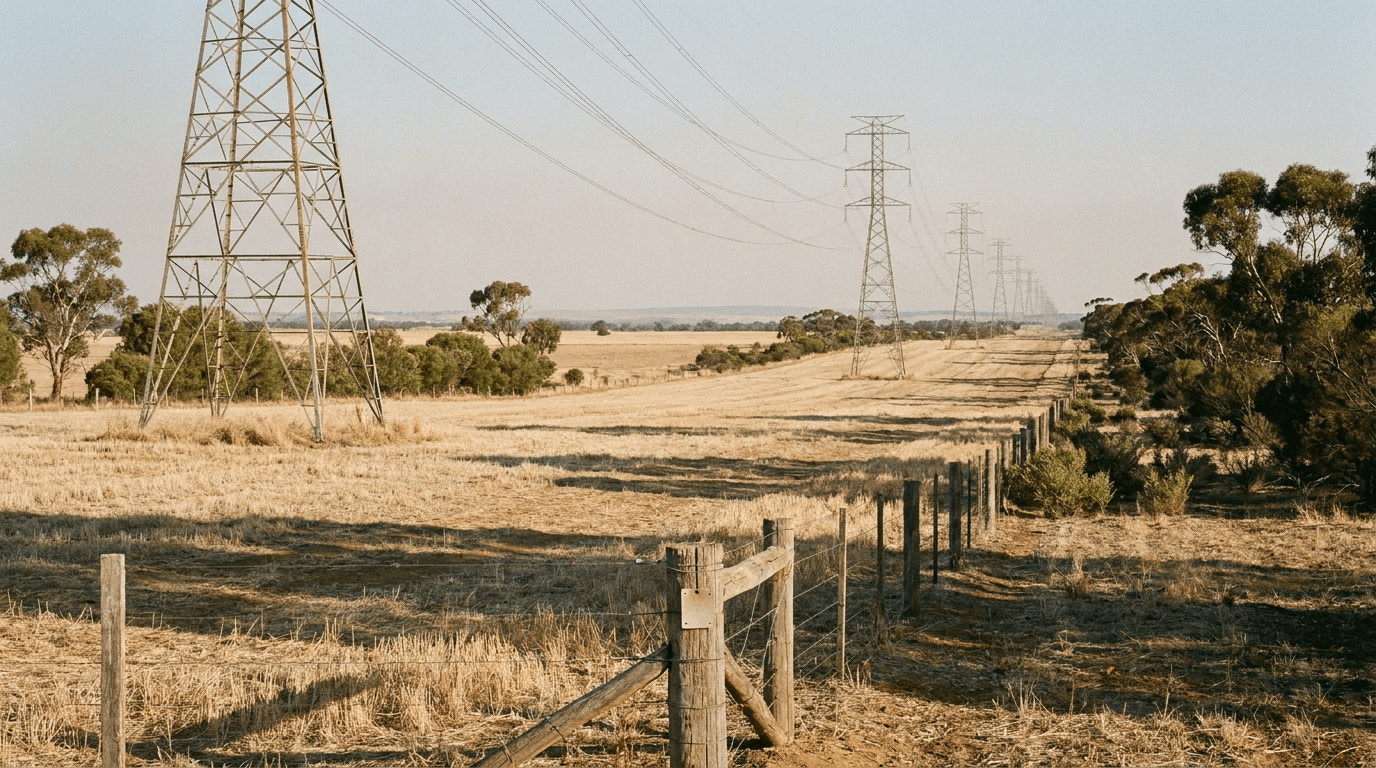
AEMO’s 2026 Integrated System Plan puts around 6,000 km of new transmission on its optimal development path to 2050 — almost a 14% extension of a network that today spans about 44,000 km — of which 3,500 km sits in committed or anticipated projects due over the next eight years. Very little of it crosses vacant Crown land. It crosses paddocks.
The owners of those paddocks are about to find out what their own state’s compensation statute says, and the answer is far less national than the phrase “just terms” implies. What a landholder near Dubbo is entitled to and what a landholder near Emerald is entitled to are fixed by two different Acts, drafted 24 years apart, which agree on market value and then part company. We read the eight statutes rather than the summaries, and what follows compares the heads that sit above market value — the ones that decide whether an offer is fair, and that first offers most often leave out.
The heads of compensation — and why only one is settled
Every Australian acquisition statute rests on the same idea: the owner should be put, so far as money can do it, in the position held before the land was taken. What each puts in the box differs, and the reason is structural. The “just terms” guarantee in s 51(xxxi) of the Constitution binds the Commonwealth — it does not bind the states. Every state entitlement is a creature of that state’s own Act.
One head is common to all eight: market value at the date of acquisition, assessed as though the project that prompted the taking did not exist. Where there is no general market for the use — a church, a scout hall, a purpose-built works — the statutes open a reinstatement path instead (NSW s 56(3), Vic s 42). The rest vary:
- Special value — the value the land holds for this owner above market value: an approval tied to the site, an adjoining holding that only works as a pair, plant installed for a use nobody else runs there. A named head in NSW, Victoria, Tasmania and the NT; absent by name in WA, SA, Queensland and the ACT, though the ACT reproduces its substance in s 45(2)(a)(ii) — keyed to ownership of the interest rather than use of the land, a distinction on which the statutes themselves divide. It depends on the owner’s own records, because the authority’s valuer cannot see it: an offer silent on special value has usually not rejected the claim, it was never put.
- Severance — the loss from cutting a holding in two. A 40-hectare paddock crossed by a corridor is not two 20-hectare paddocks.
- Injurious affection and betterment — the damage the works do to the land you keep, and any uplift they give it. NSW and Victoria fold both into one head running in each direction; Queensland splits them, and s 20(4) makes the set-off one-directional, so an owner never ends up owing money for an uplift.
- Disturbance — the cost of being moved on: legal and valuation fees, stamp duty on a replacement, mortgage discharge, removal and storage. Queensland’s list is closed yet reaches further than most expect, covering lost business profits and “other economic losses” — its own worked example is school uniforms for children enrolled at a new school. Tasmania runs the other way: under s 28, disturbance is not payable at all if the land was not at its highest and best use when the notice to treat was served.
- The non-financial head — the upheaval itself. Here the country stops agreeing altogether.
Quick reference — what each jurisdiction compensates
Market value is common ground. The head that compensates the upheaval of being moved on is not:
| Jurisdiction | The non-financial head | Ceiling in 2026 |
|---|---|---|
| NSW | Disadvantage resulting from relocation (s 60) | $101,150.81, indexed each 1 July |
| Vic | Solatium (s 44) | 10% of market value, no dollar cap |
| Qld | None | — |
| WA | Unnamed — for “the taking without agreement” (s 241(8)) | 10% of the total award, exceedable in exceptional circumstances |
| SA | Solatium (s 25A) | Lesser of 10% or $50,000 — and discretionary |
| Tas | Hardship (s 30(3)) | No cap, but only for age, infirmity or want of means |
| NT | Intangible disadvantages (Sch 2, r 9) | No cap — the tribunal’s discretion |
| ACT | Unnamed payment (s 51) | $15,000 indexed since 1994, added to the greater of ordinary compensation or replacement cost |
The second difference is structural, and it decides what an argument can be built on at all. New South Wales confines compensation to “the following matters only” (s 55) and Western Australia to the matters in s 241 “solely”, though within that section s 241(6)(e) leaves open the facts that can generate loss or damage. Tasmania’s residual head — “such other matters as … may be considered relevant” — was repealed with effect from 1 January 2020, removing the express residual discretion. The ACT runs the other way, directing regard to “all relevant matters, including” those listed (s 45(2)), and the Northern Territory further still: s 66(1) provides that its tribunal “must have regard to, but is not bound by”, the Schedule 2 rules.
Who decides also varies: the Land and Environment Court in New South Wales, the Land Court in Queensland, VCAT or the Supreme Court in Victoria depending on the amount in dispute, the State Administrative Tribunal or a court in Western Australia at the claimant’s election, the Supreme Courts in South Australia and Tasmania, NTCAT in the Territory, and ACAT in the ACT — there, only by contesting the s 63 final offer.
The head that splits the country
New South Wales prints a maximum of $75,000 in s 60(2), and that is not the operative figure: Schedule 1A indexes it to the Sydney CPI every 1 July. The NSW Government’s current statement is unambiguous — the maximum “is $101,150.81 for acquisitions on or after 1 July 2026”. An owner reading the Act alone understates their own ceiling by $26,150.81.
Victoria runs the opposite design. Section 44(1) allows an increase “not exceeding 10% of the market value of the land … for intangible and non-pecuniary disadvantages” — no dollar cap, no indexation, no residence requirement, principal residence appearing in s 44(2)(g) as one factor among seven. South Australia combines both mechanisms in the least generous way available: s 25A(4) takes 10% of market value or $50,000, “whichever is the lesser amount”, and s 25A(1) makes it discretionary in any event (“the Authority may increase”).
Queensland pays nothing at all — not a smaller amount, nothing. A full-text search of the authorised consolidation returns zero occurrences of solatium, non-pecuniary, intangible, inconvenience or principal place of residence, and the closed definition of disturbance in s 20(5) is drafted entirely in terms of costs, loss of profits and economic losses.
The two western jurisdictions take opposite routes to the same question. Western Australia has no solatium head — the word is absent from the Act — but s 241(8) allows an amount “appropriate to compensate for the taking without agreement”, capped by s 241(9) at 10% of the amount otherwise awarded “unless … exceptional circumstances justify a higher amount”. It is the only ceiling in the country that can be exceeded, and it is not confined to owner-occupiers. South Australia does the reverse: s 25(1)(g) directs that “no allowance shall be made on account of the fact that the acquisition is effected without the consent, or against the will, of any person” — reintroducing the premium only through the narrow s 25A solatium above.
Because three of the designs are proportional and two are fixed, which state is most generous depends on what the house is worth:
| Market value | NSW | Victoria | SA | Qld |
|---|---|---|---|---|
| $600,000 | $101,151 | $60,000 | $50,000 | nil |
| $1,000,000 | $101,151 | $100,000 | $50,000 | nil |
| $1,500,000 | $101,151 | $150,000 | $50,000 | nil |
| $3,000,000 | $101,151 | $300,000 | $50,000 | nil |
The South Australian cap bites at a market value of just $500,000. New South Wales has no percentage mechanism at all — its ceiling binds as soon as the assessed disadvantage passes $101,150.81 — and Victoria does not overtake it until $1,011,508, above which the Victorian percentage runs away without limit.
These are ceilings, not entitlements, and three are residence-gated — which matters in a corridor case, where the homestead is usually kept. New South Wales requires the whole of the land, or the part carrying the residence, to be taken (s 60(4)); South Australia an owner-occupier whose principal residence is acquired (s 25A(1)); the Northern Territory occupation as a principal residence plus a fee simple, life estate or leasehold (Sch 2, r 9(1)). The Victorian, South Australian and Territory provisions are discretionary on their face, and in New South Wales the Valuer General’s policy pays the full amount to a resident owner-occupier while scaling other occupants by length of residence.
Tasmania and the two Territories cannot be plotted at all. Tasmania’s hardship head has no cap but opens only where compensation is determined on the s 30(2) rehousing basis — which needs the claimant’s request and the Valuer-General’s consent — and then only where the claimant cannot rehouse “solely by reason of age, infirmity or want of means”. The Northern Territory’s is pure tribunal discretion. The ACT’s s 51 payment is a fixed indexed sum added to the greater of ordinary compensation or the cost of a reasonably equivalent dwelling — a replacement-cost floor rather than a ceiling.
The ACT carries a trap no comparison of heads will show. Section 18(3) provides that the Act “does not apply in respect of the withdrawal by the Executive from a lease of territory land … where the withdrawal is made in accordance with the provisions of the lease”. Where land comes back through the Crown lease’s own withdrawal clause rather than through an acquisition, none of this applies — not the s 45 heads, not the s 51 payment, not the ACAT route. Whatever the lease says is what there is.
When it is an easement, not a taking
Most land the energy transition needs is not taken outright but burdened with an easement — a strip the owner keeps, pays rates on and farms around, subject to a permanent right in someone else. The valuation question changes: not what the land was worth, but how much less it is worth encumbered, plus injurious affection to the balance.
The non-financial head usually does not apply. A grazier who gives up a corridor across a back paddock and keeps the homestead does not reach it: the head that dominates the comparison above is, in easement cases, frequently worth nothing.
Host payments are a separate layer, and only one state has built one properly. New South Wales runs a Strategic Benefit Payments Scheme: the equivalent of $200,000 in 2022 dollars per kilometre of transmission hosted, in annual instalments over 20 years, CPI-indexed, from the project’s energisation. It is not a media release: a licence condition under cl 6(2)(i) of Schedule 2 of the Electricity Supply Act 1995 gives it effect, with guidelines gazetted 20 June 2025 and IPART enforcing it. EnergyCo states the cumulation explicitly: the payments “are made in addition to and will not reduce any compensation paid to landholders for transmission easements as required under the Land Acquisition (Just Terms Compensation) Act 1991”.
Victoria’s headline figure is the same $200,000 per kilometre, but neither the structure nor the measure is: VicGrid describes $8,000 a year over 25 years, indexed, per kilometre “of typical easement area” rather than along the centreline New South Wales uses. It still calls the benefits “announced … in 2023”, and we could not identify any licence condition, gazetted guideline or regulator behind them.
Queensland inverts the incentive. Powerlink’s Landholder Payment Framework pays compensation under the Acquisition of Land Act 1967, a Commercial Payment in fixed amounts “not open to negotiation”, and a professional fees allowance — but it is explicit about what happens if agreement fails: “where the easement is obtained by compulsory acquisition, compensation will be assessed in accordance with the ALA, which does not include a commercial payment.” In New South Wales the host payment attaches to the easement however it is acquired, and Victoria’s announced scheme draws no such distinction on its face. In Queensland it is the price of settling: a landholder who pushes the matter into compulsory acquisition keeps every statutory entitlement and loses the top-up.
And a granted easement is taxed worse than a taking. Under TD 2018/15 the grant of an easement is CGT event D1, not A1. The ruling spells out the consequences: “no part of the cost base of the asset can be taken into account”, the gain cannot be disregarded merely because the land was acquired before 20 September 1985, it is “not a discount capital gain”, and “no exemption is available under Division 118 if the grant relates to a main residence”. A grazier on pre-CGT country who signs an easement agreement can be taxed on that part with no cost base, no 50% discount and no main residence relief. Dissection matters, though: TD 2018/15 governs the part that is consideration for granting the right, while TR 95/35 treats a part paid for permanent damage to, or a permanent reduction in the value of, the land retained as a recoupment of its cost base — and where that land is pre-CGT, states there are no CGT consequences for that part.
GST splits along the same line. Under GSTR 2006/9, where land vests in an authority because the authority initiated the acquisition, the owner “does not make a supply” and no GST arises. A negotiated easement is a supply — Powerlink publishes that it pays GST on top where the landholder is registered, and Transgrid that it will, “depending on specific circumstances”.
Methodology
- All eight statutes were read directly, in the current authorised consolidation on each jurisdiction’s own register, and every figure carries its section number.
- Absence findings were tested against neighbouring vocabulary — disadvantage, intangible, non-pecuniary, inconvenience, relocation, hardship — not just the target word, because a missing word is not a missing mechanism. South Australia has no occurrence of “betterment” and a full betterment set-off in s 25(1)(j).
- What we did not publish. The ACT’s s 51 amount is indexed automatically under s 105 with no published determination, so we give the mechanism and no figure. New South Wales publishes only the 2022 base rate for strategic benefit payments, so no current indexed rate is stated. Powerlink publishes no per-kilometre figure. No percentage-of-freehold convention for easement valuation is quoted, because no acquiring authority publishes one.
- Access limits. The NSW maximum is taken from the NSW Government’s published statement rather than the Secretary’s notice, which the legislation register would not serve us; ATO rulings were read through a reader proxy for the same reason.
Frequently asked questions
What can I claim beyond the market value of my land?
Special value, loss from severance, injurious affection to the land you keep, disturbance costs, and in most jurisdictions a payment for the non-financial upheaval of relocating. Queensland pays nothing for that last item; Western Australia does not name it, but s 241(8) allows an amount for “the taking without agreement”.
Do I get paid for the distress of losing my home?
Only in some states, and the ceilings are not comparable. New South Wales caps it at $101,150.81 from 1 July 2026; Victoria allows up to 10% of market value with no dollar cap; South Australia the lesser of 10% or $50,000, at the authority’s discretion; Queensland nothing.
Is compensation for a compulsory acquisition taxable?
It is a CGT event, and under s 104-10(6) it can happen before you are paid — the event is the earliest of payment, vesting, entry or possession. A roll-over is available under Subdivision 124-B but must be chosen, and does not shelter compensation you do not reinvest. Granting an easement is treated differently, and usually worse.
Is an easement compensated the same way as a full acquisition?
No. The measure is how much less the land is worth encumbered, plus injurious affection to the balance. The relocation head generally does not arise: in New South Wales it requires the whole of the land, or the part carrying the residence, to be taken. Host payments for transmission easements are a separate layer.
Sources:
- Compensation types — NSW Government
- Land Acquisition (Just Terms Compensation) Act 1991 (NSW)
- Land Acquisition and Compensation Act 1986 (Vic)
- Acquisition of Land Act 1967 (Qld)
- Land Administration Act 1997 (WA)
- Land Acquisition Act 1969 (SA)
- Land Acquisition Act 1993 (Tas)
- Lands Acquisition Act 1978 (NT)
- Lands Acquisition Act 1994 (ACT)
- Strategic Benefit Payments Scheme — EnergyCo NSW
- Community benefits — VicGrid
- Landholder Payment Framework — Powerlink Queensland
- 2026 Integrated System Plan — AEMO
- TD 2018/15 — grant of an easement, profit à prendre or licence and TR 95/35 — treatment of compensation receipts
General information about compulsory acquisition legislation as it bears on valuation. Not legal, financial or tax advice, and not a full summary of any Act. Entitlements turn on the interest held, the date of acquisition and the jurisdiction — confirm your position with your solicitor and tax adviser. Last verified 18 September 2026. We update this article when the legislation changes.
See also: Compulsory Acquisition in Canberra · Compulsory Acquisition Valuation · Expert Witness Valuations · Rural & Agribusiness Valuation

About the author
Tajinder Dhillon
Principal Valuer
Tajinder Dhillon is the Principal Valuer at Landmark Valuations, a RICS-regulated property valuation firm. He leads independent valuations across residential, commercial, industrial and rural property throughout Australia.
Connect on LinkedIn