Market Insights
Property Values in Darwin and the Northern Territory — What Makes Them Different

Add Landmark Valuations as a preferred source on Google
The Northern Territory is the most distinctive property market in Australia, and almost none of what makes it distinctive shows up in a portal estimate. It is the only jurisdiction with no land tax at all. It has the country’s highest rental yields and, in 2026, its strongest growth — from the lowest base of any capital. Its houses are built to a cyclone standard that splits the market by construction date, its economy leans on defence in a way no other capital does, and its land sits under a mix of tenures found nowhere else. A Darwin valuation that misses those things isn’t a Darwin valuation. Here is what actually moves the number across the Top End.
The no-land-tax advantage
Start with the one that matters most to investors: the Northern Territory is the only Australian state or territory that levies no land tax at all — regardless of how many properties you hold or their combined land value. Everywhere else charges land tax above a threshold (which we set out in the land tax by state guide); the NT charges nothing.
That is a structural holding-cost advantage. On our property taxes by state comparison, an identical investment property that generates several thousand dollars of annual land tax in Victoria or the ACT generates zero in the NT — every year, compounding over the hold. It is a genuine part of the Territory’s investment case, and it is one reason the yield story below holds up.
Australia’s cheapest capital — and, right now, its strongest
Darwin has spent years as the most affordable capital in the country, and it still is: the median house was $766,350 and the median unit $472,572 in June 2026 (Cotality), with the all-dwellings median around $638,187 — well below the other capitals. What changed is momentum. Darwin dwelling values rose about 19.8% over the year to June 2026, with units (up roughly 20.9%) outpacing houses — the strongest annual growth of any capital, from the lowest base.
That performance follows a long, deep downturn. Darwin values fell by roughly a third from their 2014 peak to a 2020 trough (CoreLogic) as the resources and LNG construction boom wound down — a fall no other capital came close to. The market a valuer reads today is a recovery off that floor, which is precisely why recent, local comparable evidence matters here: a sale from the downturn years describes a different market than the one operating now.
Two more numbers define the Territory’s investment case. Darwin carries the highest gross rental yield of any capital — around 6.1% on dwellings, and roughly 7.1% on units (Cotality, 2026), against a combined-capitals average near 3.5%. And the rental market is extraordinarily tight, with a vacancy rate around 0.3%, among the lowest in the country. High yield, no land tax, tight rentals: the holding economics are unlike anywhere else.
Cyclone country — why construction date is a value factor
Darwin sits in cyclonic Wind Region C under AS/NZS 1170.2, one of the two cyclonic wind regions in Australia. That is not a footnote; it splits the housing stock. On Christmas Day 1974, Cyclone Tracy (Category 4) destroyed or severely damaged around 70% of Darwin’s homes and became the event that reset Australia’s wind-loading codes — the standards were revised repeatedly afterward and rebuilt Darwin to cyclone-resistant requirements.
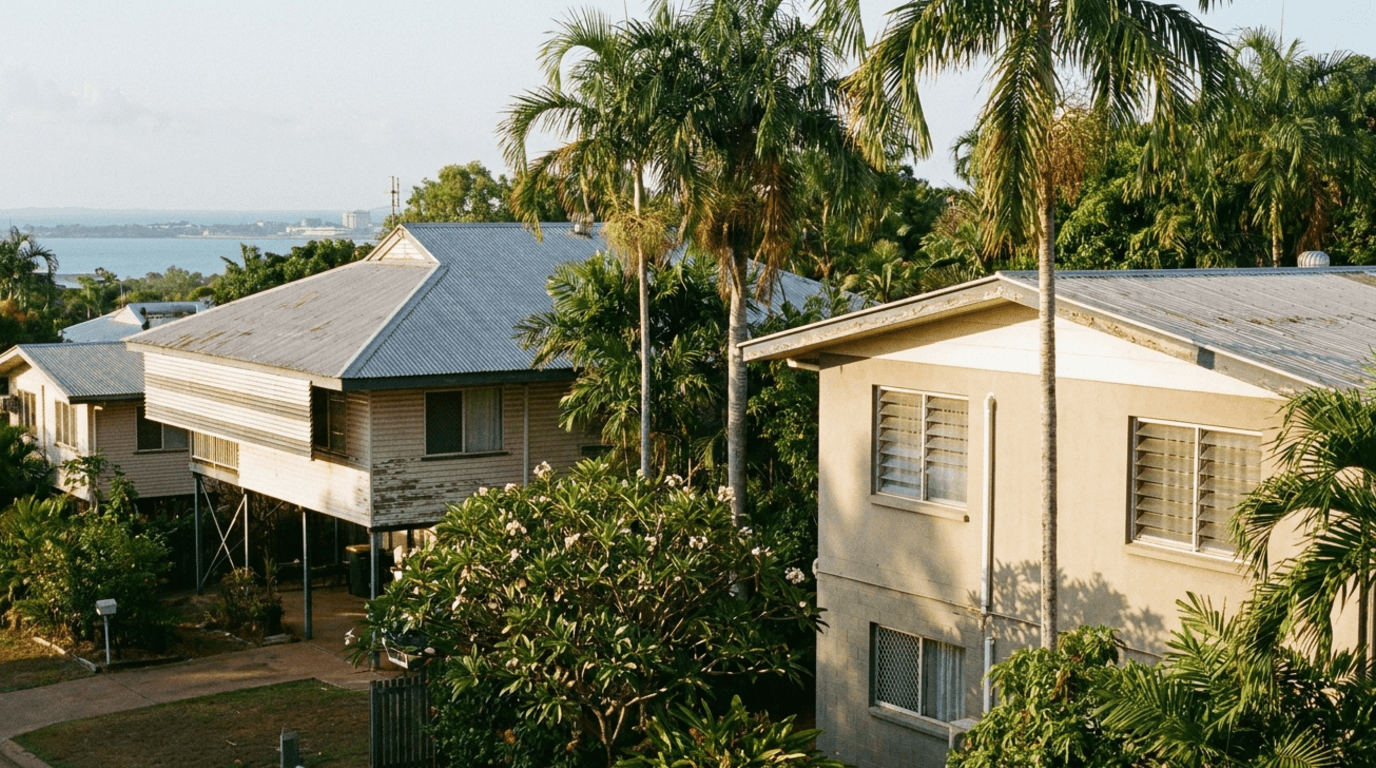
For a valuer this means the line between pre-Tracy and post-Tracy (and later-code) construction is a material value factor. Cyclone rating drives insurability and premiums, buildability, and buyer confidence; the classic elevated Darwin home on stilts, with louvres and wide eaves, is a tropical design response that also carries its own assessment considerations. Two houses of similar size and location can value quite differently on construction standard alone — a distinction an automated model, reading only sales and a suburb, cannot see.
The defence economy
No other capital leans on defence the way Darwin does. The Marine Rotational Force – Darwin (MRF-D) brings around 2,500 US Marines through the city each year, and billions of dollars of defence infrastructure are planned for the NT over the decade — Robertson Barracks, RAAF Base Darwin, Larrakeyah and the broader northern-Australia force posture. (The AUKUS submarine rotation sits in Western Australia, not Darwin; the Territory’s role is the Marine rotation and northern basing.) For property, that is a structural demand anchor in the suburbs around the bases.
It also creates a specific valuation mechanism: Defence Housing Australia (DHA) leases. DHA rents investors’ homes on secured leases of up to twelve years, paying rent monthly in advance even when the property is vacant. That guaranteed income stream changes how a defence-leased investment property is assessed — the lease itself is part of the value story, which is why defence-linked stock is analysed differently from the open rental market.
A thin market and unusual land
Two final things shape every NT valuation. First, it is a thin market: a small population means fewer transactions and, at times, sparse directly-comparable sales — recently compounded by listings running well below a year earlier while sales rose. Finding true comparables takes local depth, and the tropical calendar (a dry season from May to October, a wet season from November to April) shapes when activity concentrates. Robust methodology, not just a comparables search, carries a defensible NT valuation.
Second, the Territory rates and holds land differently. NT councils, including the City of Darwin (revalued in 2026), rate on Unimproved Capital Value under the Valuation of Land Act 1963, with a general revaluation at least every three years — and the objection window is a short 30 days from the notice (see capital improved value vs market value for how these statutory bases differ from market value). And tenure is unusually varied: freehold, Crown lease, Aboriginal freehold under the Aboriginal Land Rights Act, and pastoral leasehold all exist across the Territory, with most land outside the towns held as Aboriginal freehold or pastoral lease. Tenure type is itself a value factor — inalienable Aboriginal freehold, a pastoral lease, and a suburban fee simple are three different things to value.
What this means for a valuation
The through-line across the Top End is that the standard tools travel badly. A portal figure or an automated model reads Darwin as just another set of sales; it does not read the cyclone rating that splits the stock, the DHA lease behind an investment property’s income, the tenure on a remote title, or the fact that a downturn-era comparable no longer describes the market. Those are the things that move value — for a lender, a pre-purchase decision, an SMSF holding chasing the Territory’s yields, a family law matter or a capital gains tax event. Landmark’s valuations across Darwin and the wider Northern Territory — residential, commercial and pastoral — are built on exactly that local reading.
Frequently asked questions
Does the Northern Territory have land tax?
No. The Northern Territory is the only Australian state or territory that levies no land tax at all, regardless of how many properties you own or their combined land value. Every other jurisdiction charges land tax above a threshold, so the NT offers a structural holding-cost advantage for property investors — one of the reasons its investment case is distinctive.
What is the median house price in Darwin?
Darwin’s median house price was about $766,350 in June 2026, with units around $472,572 (Cotality) — making it the most affordable capital city in Australia. Darwin also recorded the strongest annual growth of any capital in 2026 (dwelling values up roughly 19.8% over the year), recovering off a low base after a deep downturn between 2014 and 2020. Medians are point-in-time and move each month.
Why are Darwin rental yields so high?
Darwin has the highest gross rental yield of any Australian capital — around 6.1% on dwellings and roughly 7.1% on units in 2026 — because prices remain low relative to rents, and the rental market is extremely tight, with vacancy around 0.3%. Combined with the NT’s absence of land tax, that gives Darwin investment property unusual holding economics.
How does cyclone rating affect a Darwin property valuation?
Significantly. Darwin is in cyclonic Wind Region C under AS/NZS 1170.2, and Cyclone Tracy in 1974 reset Australia’s building codes. Construction to modern cyclone standards affects insurability, insurance cost, buildability and buyer confidence, so pre-Tracy stock that hasn’t been upgraded is assessed differently from cyclone-compliant homes. Two otherwise-similar houses can value differently on construction standard alone.
What makes valuing property in the NT different from other states?
A combination found nowhere else: no land tax, cyclonic construction standards that split the housing stock, a defence-driven economy with Defence Housing Australia leases that guarantee rent, a thin market with limited comparable sales, unimproved-capital-value rating with a 30-day objection window, and an unusual mix of freehold, Crown lease, Aboriginal freehold and pastoral tenure. Each is a genuine valuation factor an automated estimate cannot capture.
Sources
- Cotality (formerly CoreLogic) — Home Value Index — Darwin median values, growth and rental yields (June 2026 release)
- NT Government — land tax and rates and the Valuation of Land Act 1963 (NT) — no land tax; Unimproved Capital Value rating
- Australian Building Codes Board / AS/NZS 1170.2 — wind regions and cyclonic construction standards
- Defence Housing Australia — DHA lease terms; Department of Defence — Marine Rotational Force – Darwin
- NT Budget — Northern Territory defence infrastructure investment
This article is general information about a regional property market, not valuation or investment advice. Median and yield figures are point-in-time (Cotality, mid-2026) and move each month; property value depends on the specific home, its construction, tenure and market — obtain an independent valuation before acting.
See also
- Property Valuation in Darwin and across the Northern Territory — our service in the Top End
- Land Tax by State Australia — 2026-27 — why the NT’s zero land tax stands out
- Property Taxes in Australia — The Total Cost by State — the NT’s holding-cost advantage in context
- Capital Improved Value vs Market Value — the UCV rating base and why it isn’t market value
- How Apartments Are Valued in Australia — relevant to Darwin’s strong unit market
Last verified: 24 July 2026. Market figures are point-in-time (Cotality, June 2026 release) and move each month; tax, rating and defence settings are current as at this date. This article is reviewed against new data.

About the author
Tajinder Dhillon
Principal Valuer
Tajinder Dhillon is the Principal Valuer at Landmark Valuations, a RICS-regulated property valuation firm. He leads independent valuations across residential, commercial, industrial and rural property throughout Australia.
Connect on LinkedIn