Market Insights
Property Values Across Geelong, the Bellarine and the Surf Coast

Add Landmark Valuations as a preferred source on Google
“The Geelong market” doesn’t really exist. What sits around Corio Bay and along the coast to the south is at least four distinct property markets — the central city and waterfront, the Armstrong Creek growth corridor, the Bellarine Peninsula, and the Surf Coast — each valued on different fundamentals, with different premiums, different supply constraints, and different overlays on the title. A number that describes one of them describes none of the others. This guide walks through what actually drives value in each, and why a regional property valuation here rests on getting the sub-market, not just the suburb, right.
The affordability engine — and its limits
The force underneath the whole region is Melbourne spillover. Greater Geelong’s median house price was $720,000 in the September 2024 quarter, about 21.4% below metropolitan Melbourne’s $916,000 (REIV) — a gap wide enough to move buyers down the highway, and the reason inland Geelong has grown as a commuter and relocation market. More recent modelled estimates put Greater Geelong nearer $790,000 in early 2026 (PropTrack), but the affordability logic is the durable point, not any single month’s figure.
One thing a valuer will not price in: the Geelong Fast Rail. The much-promised project lost its Commonwealth funding in 2023 and is being wound up — so the transport-driven uplift some sellers still reference is not a value that a defensible valuation can lean on. Pricing in infrastructure that isn’t coming is one of the more common local errors.
Central Geelong and the waterfront
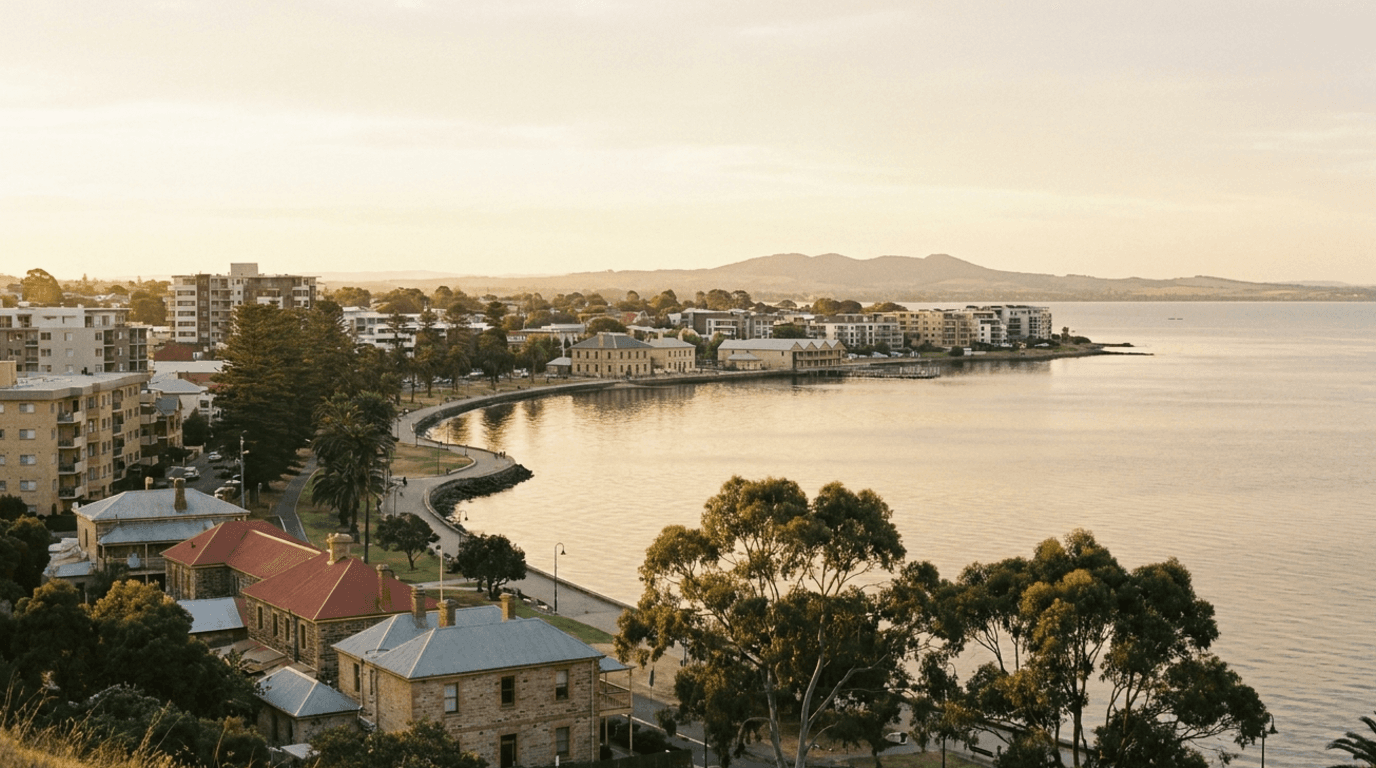
The redeveloped foreshore from Rippleside through the CBD to Eastern Beach is where the city’s post-industrial reinvention is most visible, and waterfront and bay-view positions command a clear premium over otherwise-comparable homes further inland — in Newtown, Geelong West and South Geelong especially. Two things complicate the valuation:
- Heritage overlays. Central Geelong’s Victorian streetscapes sit under an extensive Heritage Overlay, which constrains development potential — and development potential is part of value. A period house you can’t materially alter is worth something different from an identical one you can.
- Flood and coastal-hazard overlays. Land Subject to Inundation and coastal-hazard controls were gazetted across parts of Corio Bay and the Bellarine (Amendment C339ggee, January 2024, building on sea-level-rise overlays from 2020). These affect insurability, buildability and value around Corio, Newcomb and the bay’s edge — and they are exactly the kind of title-level detail a desktop estimate misses.
The growth corridor — Armstrong Creek
South of the established city, Armstrong Creek is the largest contiguous growth area in Victoria: roughly 2,500 hectares planned for about 22,000 homes and an eventual 55,000-65,000 residents. It is effectively a city being built from farmland, and it behaves like its own market — dominated by new-build houses on compact lots, with pricing driven by land release stages rather than established-suburb comparables.
Two valuation traps live here. First, in a greenfield estate the land component and the build component move separately, and a house-and-land package is not simply the sum a portal reports. Second, buying off the plan carries the settlement-valuation risk we cover in how apartments are valued: the lender values the finished dwelling at settlement, not the contract price agreed at an earlier release stage, and developer incentives don’t lift that valuation. In a fast-releasing corridor, comparable evidence shifts stage to stage, which is why a current, local read matters more here than almost anywhere else in the region.
The coast — Surf Coast and Bellarine
Down on the coast the logic inverts: instead of affordability, the driver is scarcity. Torquay, Jan Juc, Ocean Grove and Barwon Heads routinely trade above $1 million, well clear of the Greater Geelong median, with genuine beachfront well beyond that. Three structural factors hold those premiums up:
- Planning caps supply. The Surf Coast sits under a Distinctive Areas and Landscapes Statement of Planning Policy with legislated settlement boundaries around Torquay-Jan Juc and neighbouring towns (approved in 2022 and embedded in the Greater Geelong and Surf Coast planning schemes in early 2026). By fixing where growth can and can’t go, it structurally constrains land supply — which supports coastal values.
- Hazard overlays discount the wrong positions. Much of the Surf Coast hinterland toward Anglesea and Lorne carries a Bushfire Management Overlay, and a material Bushfire Attack Level rating changes both build cost and insurability. On the beach itself, coastal-erosion overlays on stretches such as Torquay’s front beach mean two homes a street apart can value very differently.
- Holiday-home economics have shifted. The Bellarine and Surf Coast are among Victoria’s largest short-stay markets, and since 1 January 2025 the state’s 7.5% short-stay levy applies to bookings under 28 nights — a real change to the investment case for a holiday let, on top of the planning and hazard constraints above.
What this means for a valuation
The through-line is that the Geelong region rewards local sub-market knowledge and punishes the generic. A portal estimate or an automated model reads a suburb and a few sales; it does not read the Heritage Overlay on a central-Geelong terrace, the erosion overlay on a Torquay block, the release stage behind an Armstrong Creek land price, or the difference between a value with a real bay view and one two streets back. Those are the things that move the number — for a pre-purchase decision, a family law or deceased estate matter, a capital gains tax event, or a lender. Landmark’s Geelong valuations cover the city, the Bellarine and the Surf Coast on that basis, with the region’s industrial and rural sub-markets handled by the same team.
Frequently asked questions
What is the median house price in Geelong?
Greater Geelong’s median house price was $720,000 in the September 2024 quarter, about 21.4% below metropolitan Melbourne’s $916,000, according to the REIV — the affordability gap that has driven relocation and commuter demand. More recent modelled estimates put it nearer $790,000 in early 2026. Medians vary widely across the region, though: the Surf Coast and coastal Bellarine trade well above $1 million.
Why is the Surf Coast so much more expensive than Geelong?
Scarcity. Towns like Torquay, Jan Juc, Ocean Grove and Barwon Heads sit under legislated settlement boundaries through the Distinctive Areas and Landscapes planning policy, which caps where new housing can go and structurally constrains land supply. Combined with beach access and lifestyle demand, that supports coastal premiums well above the Greater Geelong median.
What makes valuing an Armstrong Creek property different?
Armstrong Creek is a greenfield growth corridor of new-build houses on compact lots, so the land and build components move separately and pricing tracks land-release stages rather than established-suburb sales. Buying off the plan also carries settlement-valuation risk — the lender values the finished home at settlement, not the earlier contract price — so a current, local comparison matters more than usual.
Do bushfire and flood overlays affect property value around Geelong?
Yes. Flood and coastal-hazard overlays around Corio Bay and the Bellarine affect insurability and buildability, and Bushfire Management Overlays across the Surf Coast hinterland change build cost, insurance and value. Two nearby homes can value quite differently depending on which overlays sit on their title — detail an automated estimate does not capture.
Is the Geelong Fast Rail still happening?
No. The project lost its Commonwealth funding in 2023 and is being wound up, so a valuation cannot rely on it as a growth driver. Pricing in transport infrastructure that has been withdrawn is a common local error worth avoiding when assessing value.
Sources
- REIV — Victorian median prices via City of Greater Geelong Stats Centre (September 2024 quarter medians)
- PropTrack Home Price Index — modelled regional estimates
- Victoria’s Big Build — Geelong Fast Rail — project status (Commonwealth funding withdrawn)
- Victorian Planning — Distinctive Areas and Landscapes — Surf Coast Statement of Planning Policy and settlement boundaries
- State Revenue Office Victoria — Short stay levy — 7.5% levy from 1 January 2025
- City of Greater Geelong and Surf Coast Shire planning schemes — heritage, flood, coastal-hazard and bushfire overlays
This article is general information about a regional property market, not valuation or investment advice. Median figures are point-in-time and vary by source and geography; property value depends on the specific home, its overlays and the sub-market — obtain an independent valuation before acting.
See also
- Property Valuation in Geelong — our service across the city, the Bellarine and the Surf Coast
- How Apartments Are Valued in Australia — off-the-plan settlement risk, relevant to Armstrong Creek and coastal apartments
- What Is a Property Valuation? — the fundamentals behind every report
- Capital Improved Value vs Market Value — why the value on your rates notice isn’t your market value
- Pre-Purchase Valuation Before Auction — confirming value before you commit
Last verified: 23 July 2026. Median figures are point-in-time (REIV September 2024 quarter; PropTrack early 2026) and move each quarter; planning and overlay settings are current as at this date. This article is reviewed against new data.

About the author
Tajinder Dhillon
Principal Valuer
Tajinder Dhillon is the Principal Valuer at Landmark Valuations, a RICS-regulated property valuation firm. He leads independent valuations across residential, commercial, industrial and rural property throughout Australia.
Connect on LinkedIn