Market Insights
Property Values in Hobart and Tasmania — What Actually Drives Them

Add Landmark Valuations as a preferred source on Google
Tasmania corrected first and hardest after the 2021 peak. It is now one of the few markets in the country still climbing while the mainland capitals slide. But the headline price movement is the least interesting thing about valuing property here. Hobart sits on the most constrained residential land in Australia, its heritage stock is governed by two separate layers of control that can each veto a renovation, its councils rate on a base almost nobody outside the state understands, and its short-stay rules are tightening from three directions at once. A Hobart valuation that doesn’t read those things isn’t reading the market. Here is what actually moves the number across Tasmania.
Where the market actually sits
As at 30 June 2026, Greater Hobart’s median dwelling value was $752,760 — houses $803,094, units $587,749 — up 9.3% over twelve months, with a gross rental yield of 4.4% (Cotality). Hobart has now recovered to within 0.7% of its March 2022 peak, closing a gap that still stood at 3.5% as recently as February 2026.
Regional Tasmania is the stronger story. Its median dwelling value of $622,232 is up 13.0% over the year and sits at its peak — no residual correction at all. Launceston ($675,284, +15.3%) and the Central Highlands ($504,612, +15.9%) led the state, and regional Tasmanian rents grew 10.1% over the year, the fastest in the country alongside Darwin.
Two pieces of context matter for anyone relying on a number right now. First, the national market has turned: values fell 0.4% nationally in June 2026 — the largest monthly fall since December 2022 — after 75 basis points of rate rises, with Sydney down 3.2% and Melbourne 2.6% over the quarter. Hobart, still up 1.4% for the quarter, is one of the last capitals growing. Second, within Greater Hobart the dispersion is wide: over the year to June 2026, Hobart – North West grew 15.8% while Hobart Inner grew 4.2%. A “Hobart” median describes neither. Sub-market evidence is doing all the work.
The most constrained land in the country
Here is the structural fact underneath everything else: 97% of Hobart’s residential land carries building constraints limiting new housing, making it the hardest capital city in Australia to build a home in — an independent finding from the Australian Zoning Atlas alongside the HIA’s 2026 Planning Blueprint Scorecard (July 2026), which rated Tasmania’s planning system 2.0 out of 5.0.
The comparison is what makes that number meaningful:
| Capital | Residential land under building constraints |
|---|---|
| Hobart | 97% |
| Adelaide | 92% |
| Darwin | 88% |
| Perth | 87% |
| Brisbane | 86% |
| Sydney | 81% |
| Melbourne | 45% |
Melbourne is the outlier because of recent planning reform; Hobart sits at the opposite end. Tasmania also finished last on the HIA’s national Housing Scorecard in April 2026, with multi-unit activity running 40–60% below decade averages.
Now the paradox that makes Tasmania interesting to value. The demand engine of the 2015–2021 boom has reversed: Tasmania recorded a net interstate outflow of 348 people in the December quarter 2025, and annual population growth of 0.50% — the lowest of any Australian jurisdiction (Tasmanian Treasury, released 18 June 2026, on ABS data). Growth now rests entirely on overseas migration. Yet prices are rising. When population growth stalls and values still climb, the explanation is on the supply side — which is exactly what the 97% figure describes.
Tourism, meanwhile, is at a record: 1.4 million visitors and $3.8 billion of spend in the year to March 2026, up 4.8% and 7.8% (Tourism Tasmania, 22 July 2026). Visitors, not residents, are the demand story — and that channels straight into the short-stay question below.
Heritage — two layers, two authorities
Tasmania has one of the richest heritage stocks in Australia, and for a valuer the critical point is that two separate layers can apply to the same house:
- The local layer. If a property is heritage listed or sits within a Heritage Precinct under the Tasmanian Planning Scheme, planning approval is generally required for any use or development of the site — Hobart alone has dozens of heritage precincts.
- The state layer. If the property is also entered on the Tasmanian Heritage Register, it is of state significance under the Historic Cultural Heritage Act 1995 (Tas), and works proposals are referred to the Tasmanian Heritage Council — a second authority, with its own assessment and its own timeline. 4,945 places were permanently entered on the Register as at 30 June 2025.
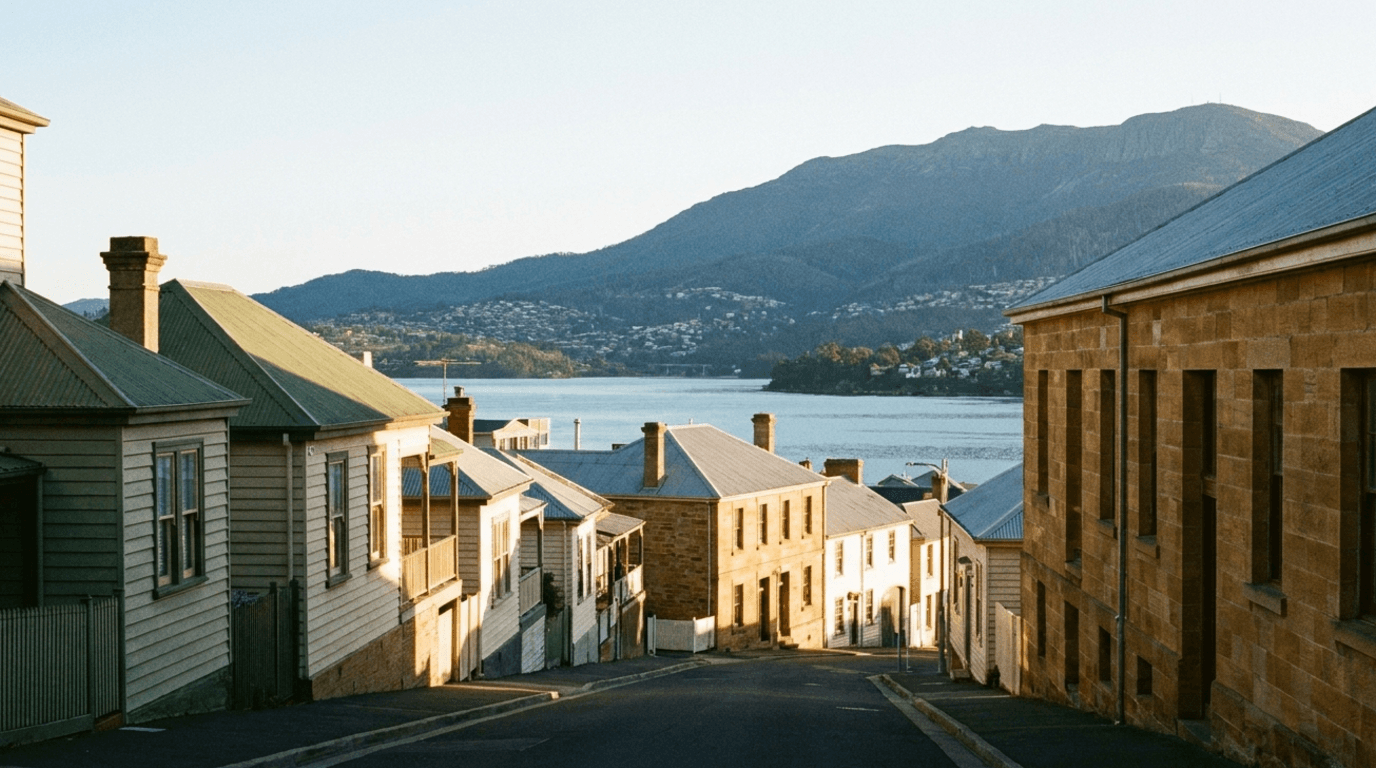
A Battery Point cottage can sit under both simultaneously. That matters to value in the specific way the City of Hobart itself frames it: heritage listing “does not mean that it cannot be changed or improved. It means that any modifications need to be thoroughly assessed” — so the character premium is real, and so is the constraint on development potential.
One statistic captures how often this now bites in practice: the Heritage Council issued 1,730 Certificates of Affected/Not Affected Place in 2024-25, against 1,412 the year before — a 22.5% jump. Those certificates are typically pulled during transactions and due diligence. Heritage is becoming a routine checkpoint in Tasmanian conveyancing, not an edge case, and it processed 656 minor-works approvals and 224 discretionary permit applications in the same year.
Short-stay — tightening from three directions
Tasmania’s short-stay rules are widely misunderstood, partly because the planning regime and the tax treatment are moving at different speeds.
The planning regime is stable and has been since 2019. Under the Short Stay Accommodation Act 2019 (Tas) and the Tasmanian Planning Scheme, short-stay letting is exempt from a planning permit only where the dwelling is the owner-occupier’s primary place of residence — and then only while the owner is away, or where visitors occupy no more than four bedrooms while the owner lives there. Everything else, which means effectively all whole-home letting that isn’t the owner’s home, requires a planning permit from the council. Platforms must display a listing’s permit status and report quarterly to the Director of Building Control. Statewide there were 3,844 non-primary residential properties on the short-stay market, up 24% since 2019 (TasCOSS/LGAT, February 2026), and a state short-stay dashboard launched in May 2026.
The tax treatment is where 2026 changed. A 5% Short Stay Levy on stays under 28 nights passed Tasmania’s House of Assembly on 7 May 2026 (22 votes to 9, with farm-stay and agritourism exempted by amendment) with a targeted commencement of 1 July 2026. Critically, unlike Victoria’s equivalent, the Tasmanian levy as drafted would apply even where the property is the owner’s principal residence. Its passage through the Legislative Council was not confirmed as at the date of this article, so anyone modelling short-stay income should confirm the levy’s current status with the State Revenue Office rather than assume it applies.
Council costs are rising independently. Hobart City Council voted on 28 April 2026 to lift the discretionary “change of use to visitor accommodation” application fee from $435 to $5,000 — a tenfold increase — from 1 July 2026. Short-stay properties in Hobart have also paid double the residential rate since 2023; a proposal to take that differential to 400% was defeated on a tied vote in May 2026. Tellingly, the council reports that more than 100 additional short-stay permits were approved after the rates doubled: on the evidence so far, holding costs alone have not stopped conversion.
For a valuer, the practical consequence is that short-stay income is no longer a simple yield uplift. It is a permitted-use question first, then a cost question, and the answer differs house by house.
The rating base nobody explains: AAV
Tasmanian councils may rate on Assessed Annual Value (AAV), capital value or land value — and AAV is the most common. It is unlike the bases used in most of the country, because it is a rental figure rather than a capital sum: under the Valuation of Land Act 2001 (Tas), AAV is the gross annual rent a property might reasonably be expected to earn, subject to a floor of 4% of its capital value.
Two consequences follow. Tasmania runs fresh municipal valuations roughly every six years, with market adjustment factors applied in between — one of the longest cycles in Australia, so the value on a rates notice can lag the market by years. And land tax runs on a different base again (assessed land value, with a $125,000 threshold and 1.5% above $500,000, plus a 2% Foreign Investor Land Tax Surcharge with no threshold). The objection window is 60 days. None of these figures is market value — see capital improved value vs market value for how the statutory bases differ, and land tax by state for Tasmania’s settings in national context.
Councils, asset valuation and the Auditor-General
Tasmania is unusual in that the Tasmanian Audit Office audits all 29 councils (in some states councils appoint their own private auditors), which makes the sector’s asset valuation practices unusually visible — and the picture is pointed.
The Auditor-General’s Local Government report tabled 16 March 2026 (for the year to 30 June 2025) found the sector’s asset sustainability ratio falling: urban councils from 87.3% to 82.5%, rural councils from 101.0% to 88.8% against a 100% benchmark. Only 6 of 29 councils met the benchmark in 2024-25, and 14 have never met it across the four years analysed. Collective capital expenditure reached only 87.3% of budget.
More directly relevant to valuation quality, the Audit Office identified as a sector-wide weakness “gaps in the management of infrastructure, including poor documentation, inadequate valuation processes and a lack of rigour to the management of work in progress” — with high-risk valuation findings named at councils including Tasman (overdue building revaluation and oversight of the valuation process), Southern Midlands (stormwater valuation), Waratah-Wynyard and Circular Head (land under roads), Derwent Valley, Brighton (indexation of fixed assets) and Hobart City (buildings on council-owned land). Hobart City also restated prior-period errors traced to a 2021 asset-system migration in which accumulated depreciation from revaluations and indexations was not applied correctly across buildings, land improvements, pathways, stormwater and roads.
That is the case for disciplined, independent revaluation in this state, made by the auditor rather than by us. Our asset valuation work covers Tasmanian councils and government entities — land and buildings, infrastructure on a depreciated replacement cost basis, and plant and equipment — and the state-by-state survey of council revaluation requirements sets out where Tasmania’s obligations sit relative to the mainland.
What this means for a valuation
Tasmania punishes generic tools more than most markets. An automated estimate reads a suburb and a handful of sales; it does not read the two heritage layers on a Battery Point title, whether a whole-home short-stay use is actually permitted, a rates notice built on a rental-value base six years stale, or the difference between an inner-Hobart street growing 4% and a northern suburb growing 16%. Thin listing volumes make the comparable-evidence problem worse, not better. Those are the things that decide the number — for a lender, a pre-purchase decision, an SMSF holding, a family law or deceased estate matter, or a capital gains tax event. Landmark values residential, commercial and rural property across Hobart, Launceston and the rest of Tasmania on exactly that basis.
Frequently asked questions
What is the median house price in Hobart?
Greater Hobart’s median dwelling value was $752,760 as at 30 June 2026 — houses $803,094 and units $587,749 — up 9.3% over the year, with a gross rental yield of 4.4% (Cotality). Hobart is now within about 0.7% of its March 2022 peak. Regional Tasmania’s median dwelling value was $622,232, up 13.0% and sitting at its peak. Medians are point-in-time and move monthly.
Do I need a planning permit for short-stay accommodation in Tasmania?
Usually yes, unless the property is your primary place of residence. Under the Short Stay Accommodation Act 2019 and the Tasmanian Planning Scheme, the permit exemption covers letting your own home while you are away, or letting up to four bedrooms while you live there. Whole-home letting of a property that is not your principal residence generally requires a council planning permit, and platforms must display the permit status.
Is there a short-stay levy in Tasmania?
A 5% Short Stay Levy on stays under 28 nights passed Tasmania’s House of Assembly on 7 May 2026 with a targeted 1 July 2026 start, and as drafted it would apply even where the property is the owner’s principal residence — unlike Victoria’s equivalent. Its passage through the Legislative Council was not confirmed when this article was published, so confirm the current position with the State Revenue Office before relying on it. Separately, Hobart City Council lifted its discretionary visitor-accommodation application fee from $435 to $5,000 from 1 July 2026.
How does heritage listing affect property value in Hobart?
Two layers can apply. Local heritage listing or a Heritage Precinct under the planning scheme means planning approval is generally needed for use or development. If the property is also on the Tasmanian Heritage Register — 4,945 places as at 30 June 2025 under the Historic Cultural Heritage Act 1995 — works are referred to the Tasmanian Heritage Council as well. Listing adds a character premium while constraining development potential, and both effects have to be assessed.
What is Assessed Annual Value (AAV) in Tasmania?
AAV is the rating base most Tasmanian councils use: the gross annual rent a property could reasonably be expected to earn, with a floor of 4% of its capital value, under the Valuation of Land Act 2001. It is a rental figure, not a capital sum, which makes it unlike the bases used in most other states. Tasmania also revalues municipalities only about every six years with adjustment factors in between, so a rates notice can lag the market — and land tax runs on assessed land value, a different base again.
Sources
- Cotality (formerly CoreLogic) — Home Value Index — Hobart and regional Tasmania medians, growth, yields and peak positions (index as at 30 June 2026)
- Housing Industry Association — 2026 Planning Blueprint Scorecard and Housing Scorecard (Tasmanian planning constraints, July and April 2026)
- Tasmanian Department of Treasury and Finance — National, State and Territory Population, December quarter 2025 (released 18 June 2026)
- Tourism Tasmania — Tasmanian Visitor Survey, year ending March 2026
- Historic Cultural Heritage Act 1995 (Tas) and the Tasmanian Heritage Council Annual Report 2024-25 — Register scale and approvals volumes
- Short Stay Accommodation Act 2019 (Tas) and the State Planning Office short-stay fact sheet (September 2025); State Revenue Office Tasmania for the levy’s current status
- Valuation of Land Act 2001 (Tas) — Assessed Annual Value
- Tasmanian Audit Office — Report of the Auditor-General No. 8 of 2025-26, Volume 4: Local Government (tabled 16 March 2026)
This article is general information about a regional property market, not valuation, tax or investment advice. Market figures are point-in-time and move monthly; planning, heritage, rating and short-stay settings change — confirm the current position with the relevant authority and obtain an independent valuation before acting.
See also
- Property Valuation in Hobart, Launceston and across Tasmania — our service in the state
- Council Asset Revaluation Requirements by State — where Tasmania’s council obligations sit nationally
- Capital Improved Value vs Market Value — AAV and the other statutory bases explained
- Land Tax by State Australia — 2026-27 — Tasmania’s thresholds and the FILTS surcharge
- Property Values in Darwin and the Northern Territory — the other distinctive small-capital market
Last verified: 25 July 2026. Market figures are Cotality’s index as at 30 June 2026 and move monthly; the national market turned negative in June 2026, so treat all price commentary as point-in-time. The Short Stay Levy’s status was unconfirmed beyond the House of Assembly at publication. This article is reviewed against new data releases.

About the author
Tajinder Dhillon
Principal Valuer
Tajinder Dhillon is the Principal Valuer at Landmark Valuations, a RICS-regulated property valuation firm. He leads independent valuations across residential, commercial, industrial and rural property throughout Australia.
Connect on LinkedIn